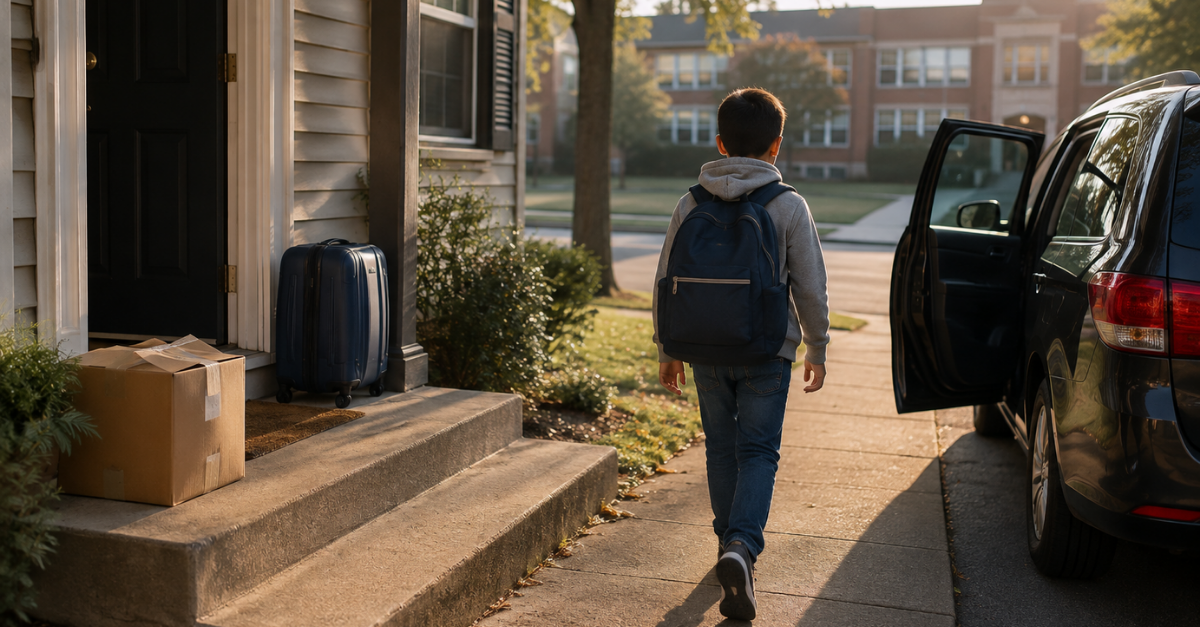
For thousands of children in foster care, change is not an occasional event. It can be part of everyday life.
Today, approximately 400,000 children and youth are in foster care in the United States at any given time, according to the U.S. Department of Education.[1]
For many, entering foster care or moving to a new placement can mean a new home, a different neighborhood, and a completely different daily routine. Historically, U.S. Department of Education materials have reported that children and youth in out-of-home care experience an average of one to two home placement changes per year.[2]
But a change in where a child lives should not automatically mean a change in where they learn.
School as a source of continuity
School is more than a classroom. It can mean familiar teachers, friends, activities, routines, and trusted adults. For a child navigating changes outside of school, preserving those relationships can provide an important source of continuity.
Yet foster care placement changes and school changes have historically been closely connected. Research highlighted by the U.S. Department of Education's Institute of Education Sciences found that nearly one-third of students in Colorado who entered foster care also changed schools at the same time.[3]
The consequences can accumulate. Another study of Colorado students in foster care found that they changed public schools an average of 3.46 times during their first four years of high school. As the number of school changes increased, the likelihood of earning a high school diploma decreased.[4]
Why federal policy protects school stability
This is why federal education policy seeks to protect educational stability. Under the Every Student Succeeds Act (ESSA), students entering foster care or experiencing a placement change should remain in their school of origin unless doing so is determined not to be in their best interest.[5]
That protection raises a practical question: what happens when the school stays the same, but home doesn't?
A new placement can put a student farther away from school or outside an established school bus route. Suddenly, a trip that once fit naturally into a transportation system may require a completely different solution.
Where transportation comes in
Transportation, then, becomes more than getting from point A to point B. It can be what allows a student to keep seeing the same teachers, learning alongside the same classmates, and continuing their education without another unnecessary disruption.
Federal requirements recognize this connection: school districts covered by the relevant Title I provisions must collaborate with child welfare agencies to ensure transportation to a student's school of origin when it is needed.[5]
But making that possible requires transportation systems capable of responding when a student's circumstances change. That is where specialized student transportation can complement traditional school transportation.
At Route A, students in foster care are one of the populations our work can impact as we support school districts and communities with reliable transportation for students with different and sometimes unique mobility needs.
Because behind every route is a student whose circumstances we may never fully see, and sometimes, a reliable ride to school means something much bigger than transportation.
Learn more about how we're helping school districts and communities keep students moving forward.
Meet Route A